
AI systems like ChatGPT, Claude and Perplexity are fundamentally changing how companies are found: those who do not appear in their answers lose customers without knowing it. According to recent studies, around 30 percent of all AI citations come from media articles, with over 80 percent from earned sources overall. Strategic media relations have become the most powerful lever for visibility in the AI age.
How Customers Make Decisions Today
Not long ago, the answer to how customers find a company was straightforward: Google, search engine optimisation, rankings. Today, a growing number of people do not search in traditional search engines at all. They ask ChatGPT, Claude or Perplexity. These systems respond directly, without the user visiting a website, reading an article or making a single click.
The consequence is clear: companies that do not appear in these AI answers lose customers without even realising it.
AI Does Not Invent. It Cites.
A common misconception is that AI systems fabricate information about companies and brands. This can happen, but it is not the norm. In practice, AI response systems draw on indexed web content, established media sources and trusted third-party references. Those who are present there get cited. Those who are not simply do not exist for the AI.
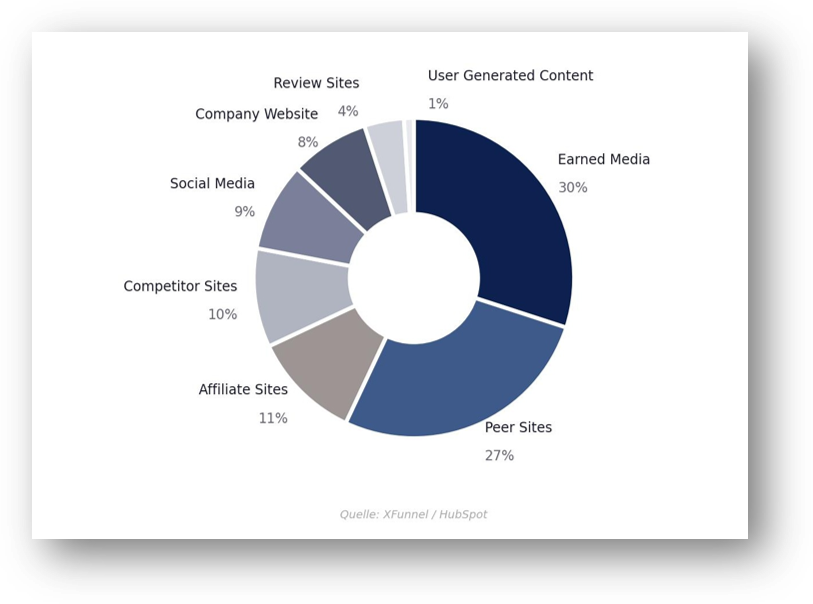
According to a study by XFunnel, around 30 percent of all AI citations come from media articles (earned media), more than from any other single source category. Overall, more than 80 percent of all AI sources come from earned sources, including media articles, research, government sources and encyclopaedias.
Media relations are therefore the most powerful lever for being found in AI search.
From Placement Logic to the Logic of Machine Perception
Media relations no longer work solely on the old logic: place an article, achieve reach, generate attention. They now follow a new, parallel logic: that of machine perception.
What matters is no longer simply whether a brand is mentioned, but in what context, with what tone, and with what consistency across different sources. Recurring patterns across media coverage, specialist articles, studies and institutional content shape how a company is framed in AI answers. A single article helps. A systematic presence in relevant media builds, over time, a stable and credible information base that AI systems recognise as a reliable source.
Specialist Media Are Gaining Strategic Importance
Those who believe AI visibility is built exclusively through major features in daily newspapers are thinking too narrowly. AI systems do not only weight reach. They also weight thematic authority, specialist depth and semantic consistency. A contribution in a recognised industry publication can do more to shape how a company is positioned than a brief mention in a mass-market outlet.
This is particularly true for B2B companies, technology providers, industrial firms and consultancies: AI systems draw on specialist sources as important signals of expertise and credibility. Media relations should therefore be evaluated not only by reach, but by their impact on the long-term information architecture of an organisation.
What This Means for Switzerland
Switzerland presents a specific context: a multilingual and relatively concentrated media market. SRG SSR, TX Group, CH Media, Ringier and the NZZ Media Group shape a large share of publicly visible coverage. Since AI systems draw on publicly available sources, these media indirectly form the basis of many AI-generated answers on Swiss topics.
At the same time, multilingualism and federal structures mean that topics translate differently into German-, French- and Italian-speaking as well as international information spaces. Those seeking to build AI visibility in Switzerland must think in terms of both language regions and media strategy.
Those Who Act Now Will Not Be Invisible Tomorrow
Most companies have not yet recognised this shift. That is an opportunity. Those who invest in strategic media relations now will secure a lasting AI visibility advantage, before the market has fully internalised this logic.
This is not about replacing what works. Strong journalist relationships, relevant topics, clear messages: that remains the foundation. But a new layer is needed, namely the deliberate construction of a coherent information and source base that is accessible to both human readers and machine processing.


.jpg)